Adoption Confidence Academy™
Adoption Confidence Academy™ — by IDCA®
70% Human. 30% Technology. All Confidence.
Technology Doesn't Create Value Until People Adopt It.
Adoption Confidence Academy™ develops the human capabilities people need to participate in technology initiatives, influence solutions, validate whether those solutions support real work, build trust in the resulting systems, and confidently incorporate them into everyday decisions and processes.
The Adoption Gap
Deployment Is Not Adoption.
A platform can be technically successful—implemented on time, configured correctly, and made available to users—while producing disappointing business outcomes. The missing element is often not technology. It is adoption.
Go-live is an event.
Adoption is a capability.
The Model
From User Involvement to Business Value
People are more likely to adopt what they understand, influence, trust, and know how to use in their work.
Dimension 01
Participation
Were the right users meaningfully involved?
Users who will rely on a system must help shape it. Meaningful involvement — not mere attendance — builds the foundation for trust and ownership.
Dimension 02
Readiness
Do users understand the purpose, workflow, expectations, and behaviors required?
Adoption requires more than awareness. Users must understand why the system exists, how it changes their work, and what new behaviors are expected.
Dimension 03
Trust
Do users trust the data, processes, workflows, and outputs?
If users do not trust the information a system produces, they will work around it. Trust is earned through involvement, validation, and transparency.
Dimension 04
Utilization
Has the capability become part of how work and decisions actually happen?
True adoption is measured not by login frequency but by whether the system has become embedded in real work, real decisions, and real outcomes.
Adoption Confidence Capabilities™
Build Adoption Before Go-Live.
The initial Adoption Confidence Capability™ portfolio develops capability across three critical stages of technology-enabled transformation.
ACC-001
Adoption Confidence Foundations™
Build a shared understanding of why enterprise technology adoption succeeds or fails and the human conditions required for sustainable adoption.
Explore PathwayACC-002
User Voice & Requirements Confidence™
Turn business users from requirements recipients into capable solution participants who can articulate needs, evaluate prototypes, and provide constructive feedback.
Explore PathwayACC-003
User Acceptance & Decision Validation™
Validate more than whether the system works. Validate whether people can confidently work and decide with it.
Explore PathwayThe Adoption Confidence Capability Architecture™
Three Pathways. Four Levels. One Capability System.
Adoption Confidence Academy™ develops capability across three critical dimensions of technology-enabled transformation. Each pathway progresses through four developmental levels—from understanding the capability, to applying it, to leading others, to institutionalizing it across the enterprise.
Explorer
Understand
Practitioner
Apply
Leader
Lead
Champion
Institutionalize
ACC-001
Adoption Confidence Foundations
ACC-002
User Voice & Requirements Confidence
Scroll vertically to explore all pathways and levels.
Adoption Confidence Lifecycle™
From Involvement to Sustained Adoption
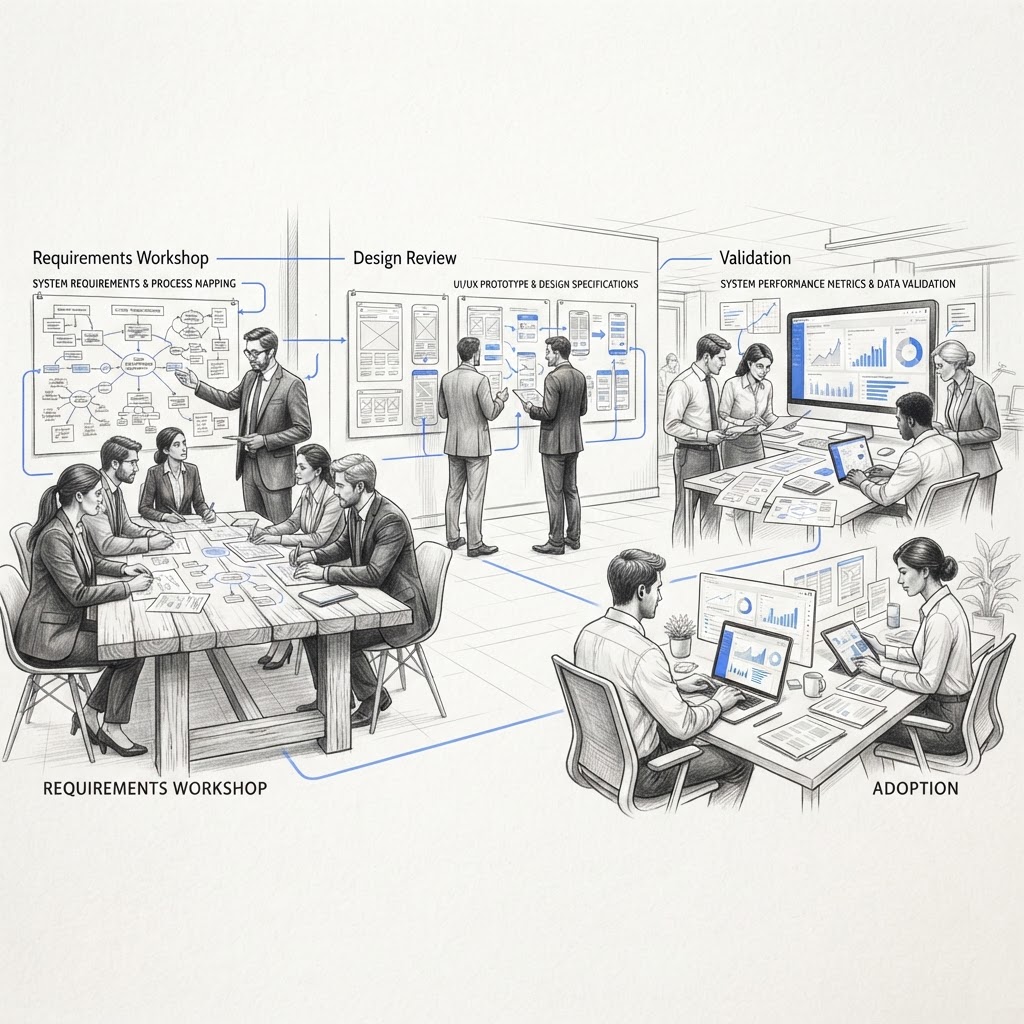
INVOLVE
Engage the right users at the right time.
SHAPE
Translate user voice into requirements and design.
VALIDATE
Confirm the solution is usable, trusted, and decision-ready.
ADOPT
Move from go-live to meaningful, sustained use.
SUSTAIN
Institutionalize adoption as an enterprise capability.
INVOLVE
Engage the right users at the right time.
SHAPE
Translate user voice into requirements and design.
VALIDATE
Confirm the solution is usable, trusted, and decision-ready.
ADOPT
Move from go-live to meaningful, sustained use.
SUSTAIN
Institutionalize adoption as an enterprise capability.
ACC-001
Adoption Confidence Foundations
Spans the lifecycle by developing the human conditions required for sustainable adoption.
ACC-002
User Voice & Requirements Confidence
Concentrates primarily on Involve + Shape.
ACC-003
User Acceptance & Decision Validation
Concentrates primarily on Validate + Adopt.
Champion-level capability strengthens SUSTAIN across all three pathways.
Go-live is an event.
Adoption is a capability.
Enterprise Adoption Confidence™
An Engagement, Not Just a Capability Experience
Organizations do not need to purchase the capabilities only as standalone experiences. IDCA can construct an Adoption Confidence engagement around an active technology initiative.
BASELINE
Adoption Confidence assessment
BUILD
Selected ACC experiences
APPLY
Implementation-based capability artifacts
MEASURE
Adoption Confidence Index™
SUSTAIN
Post-go-live measurement and governance
BASELINE
Adoption Confidence assessment
BUILD
Selected ACC experiences
APPLY
Implementation-based capability artifacts
MEASURE
Adoption Confidence Index™
SUSTAIN
Post-go-live measurement and governance
Suggested Measurement Points
Adoption Confidence Index™
Four core dimensions, measured over time
Dimension 01
PARTICIPATION
Are the right users meaningfully involved?
Dimension 02
READINESS
Do users understand the purpose, workflow, expectations, and behaviors required?
Dimension 03
TRUST
Do users trust the data, workflows, processes, and outputs?
Dimension 04
UTILIZATION
Has the capability become part of how work and decisions actually happen?
The Adoption Confidence Index™ is an IDCA structured diagnostic and longitudinal measurement framework. It is not a scientifically validated external industry benchmark.
Technology Agnostic
One Human Adoption Challenge. Many Technologies.
Adoption Confidence Academy™ is intentionally technology-agnostic. The capabilities address the human behaviors and competencies that determine whether organizations successfully translate technology investment into operational capability.
Who This Is For
Built for the people who determine adoption
Business Users
Managers & Supervisors
Subject Matter Experts
Process Owners
Analytics Users
Project Team Participants
UAT Participants
Adoption Champions
Business Analysts
Transformation Leaders
Adoption Friction™
Resistance Is Information.
Low adoption should not automatically be interpreted as unwillingness to change. Adoption Friction™ can reveal important conditions that deserve attention — not blame.
Adoption Confidence Academy™ helps organizations identify, understand, and address these conditions rather than treating adoption as a communication problem alone. Importantly, individual employees are not labeled "saboteurs" — the more constructive IDCA concept is Adoption Friction™.
70% Human. 30% Technology. All Confidence.
Don't Wait Until Go-Live to Think About Adoption.
Build adoption capability while the solution is still being shaped.
Important Clarification
Adoption Confidence Academy™ develops the human capabilities that strengthen enterprise technology adoption. It is not a substitute for organizational change management, project management, business analysis, technical implementation, or software training. Rather, it is the human capability layer that complements and strengthens those disciplines. Adoption Confidence Capabilities™ (ACCs™) are educational experiences, not software training or technical certification programs. IDCA® does not guarantee specific adoption outcomes — adoption depends on organizational commitment, sponsorship, and sustained effort beyond any single program.