Adoption Confidence Academy™
ACC-003-E | Explorer | Understand
User Acceptance & Decision Validation Foundations™
Core Question
What am I actually supposed to validate during User Acceptance Testing?
Your Pathway
User Acceptance & Decision Validation Pathway
Select a level to explore capability outcomes, assessments, delivery, and investment.
Capability Purpose
Develop the capability to determine whether technology is technically functional, usable, trusted, workflow-aligned, decision-ready, and suitable for sustainable business adoption.
Intended Audience
UAT participants, business users, process owners, and subject matter experts responsible for evaluating whether a solution is ready for adoption.
Capability Family
User Acceptance & Decision Validation™
Why This Capability Exists
The problem this level solves
Traditional User Acceptance Testing often focuses on whether system functionality behaves as specified. That is necessary—but insufficient. A technically correct platform can still fail users because workflows are impractical, information is difficult to interpret, or outputs do not support actual decisions. When UAT confirms only that the system works technically, adoption risk remains hidden until go-live.
This Capability Builds
What participants develop
Measurable Learning Outcomes
Participants will be able to
Capability Architecture
What the capability covers
Testing vs. Acceptance
Why confirming technical functionality is not the same as confirming business readiness.
Business Scenarios
Constructing validation scenarios from actual work.
Workflow Validation
Validating end-to-end workflows including exceptions.
Data Validation
Evaluating whether users can trust the data the system produces.
Usability
Identifying usability barriers that will undermine adoption.
Decision Readiness
Determining whether outputs support the decisions users make.
Identifying Adoption Risk
Recognizing adoption risk before go-live, not after.
Documenting Findings
Turning observations into structured, actionable findings.
Applied Activities
Learning by doing
Required Assessment
User Acceptance & Decision Validation Foundations Assessment™
Scenario questions, knowledge checks, concept classification, and applied reflection.
Capability Evidence / Deliverable
Decision Validation Checklist™
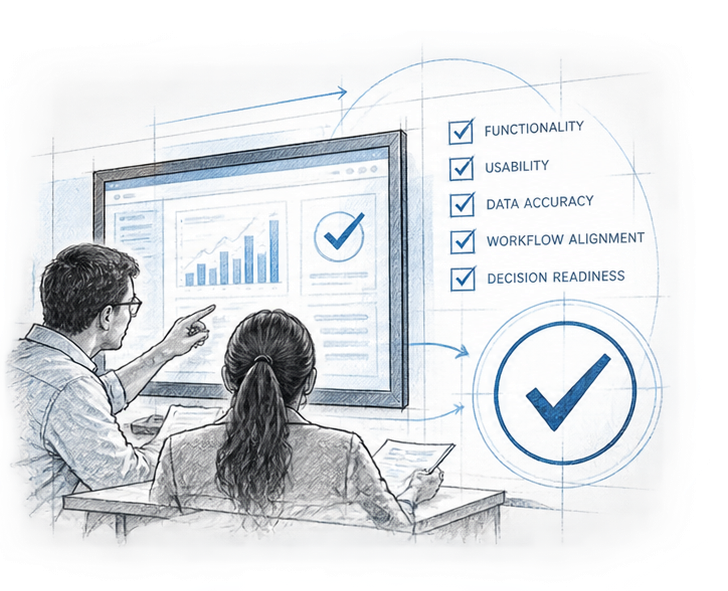
A structured checklist covering functionality, usability, data confidence, workflow alignment, and decision readiness for a selected solution.
Business Outcomes
What the organization gains
Technology Applicability
One Human Adoption Challenge. Many Technologies.
Applies to ERP implementations, analytics/BI deployments, AI projects, CRM transformations, EHR implementations, HRIS transformations, data-platform deployments, and automation initiatives.
Delivery Model
Live virtual, in-person, or hybrid delivery. Cohort-based for scenario development and applied exercises.
Delivery & Investment
Cohort Investment
All Adoption Confidence Capabilities™ are delivered as instructor-led cohort experiences. Pricing is per cohort, not per participant.
5-Person Cohort
$7,500
Designed for focused teams, project groups, or selected business-user representatives.
Request This Cohort10-Person Cohort
$12,500
Designed for functional teams, implementation workstreams, or broader user-representative groups.
Request This Cohort20-Person Enterprise Cohort
$22,500
Delivered as TWO COORDINATED 10-PERSON COHORTS to preserve participant involvement, discussion quality, applied exercises, instructor interaction, and meaningful user participation.
Delivered as two coordinated 10-person cohorts
Request This CohortPricing Includes
Virtual delivery included. For in-person or hybrid delivery, travel and related delivery expenses may apply.
Enterprise
Need to Enable More Than 20 Participants?
Enterprise Adoption Confidence engagements are available for larger implementations, multi-function deployments, transformation programs, and organization-wide adoption initiatives.
Discuss an Enterprise Adoption Confidence EngagementWhere Should I Enter?
Not sure which level is right for you?
You do not need to begin at Explorer. Use the Adoption Confidence Level Readiness Assessment™ to identify the most appropriate entry level within this pathway.
Related Adoption Confidence Capabilities™
The three pathways work together
ACC-001
Adoption Confidence Foundations
Build a shared understanding of why enterprise technology adoption succeeds or fails and the human conditions required for sustainable adoption.
ACC-002
User Voice & Requirements Confidence
Turn business users from requirements recipients into capable solution participants who can articulate needs, evaluate prototypes, and provide constructive feedback.
70% Human. 30% Technology. All Confidence.
Build Adoption Capability Across Your Organization
Important Clarification
Adoption Confidence Academy™ develops the human capabilities that strengthen enterprise technology adoption. It is not a substitute for organizational change management, project management, business analysis, technical implementation, or software training. Rather, it is the human capability layer that complements and strengthens those disciplines. Adoption Confidence Capabilities™ (ACCs™) are educational experiences, not software training or technical certification programs. IDCA® does not guarantee specific adoption outcomes — adoption depends on organizational commitment, sponsorship, and sustained effort beyond any single program.